

• Skip to primary navigation
  • Skip to main content
  • Skip to footer
Cyara

Cyara

Cyara Customer Experience Assurance Platform

  • Login
  • Contact Us
  • Request a demo
  • Login
  • Contact us
  • Request a demo
  • Why Cyara
    • AI-Led CX Assurance Platform
    • AI vision for CX
    • Cyara partner network
    • Cyara Academy
  • Solutions
    • Transform
          • TRANSFORM – Drive CX Change

          • Functional, regression, & objective testing | Cyara Velocity
          • Performance testing | Cyara Cruncher
          • See all use cases >
          • Cyara platform - Transform - Drive CX change
    • Monitor
          • MONITOR – Assure CX Journeys

          • Telecom assurance | Cyara Voice Assure
          • CX & telecom monitoring | Cyara Pulse 360
          • Call ID line assurance | Cyara Number Trust
          • Agent environment assurance | Cyara ResolveAX
          • CX monitoring | Cyara Pulse
          • See all use cases >
          • Cyara platform - Monitor - Assure CX journeys
    • Optimize
          • OPTIMIZE — Leverage AI for CX

          • Conversational AI optimization | Cyara Botium
            • Functional & regression testing for AI agents
            • LLM-driven AI agent testing
            • Load testing for AI agents
            • NLP analytics for conversational AI in CX
          • Generative AI assurance | Cyara AI Trust
          • See all use cases >
          • Cyara platform - Optimize - Leverage AI for CX
    • Connect
          • CONNECT — Assure WebRTC CX

          • WebRTC optimization | Cyara testRTC
          • WebRTC monitoring | Cyara watchRTC
          • WebRTC quality assurance | Cyara qualityRTC
          • See all use cases >
          • Cyara platform - Connect - Assure WebRTC CX
  • Resources
    • CX Assurance blog
    • Customer success showcase
    • CX use cases
    • Events & upcoming webinars
    • On-demand webinars
    • Resource library
    • Customer community
  • About Us
        • About Cyara

        • About Cyara
        • Leadership
        • Careers
        • Legal statements, policies, & agreements
        • Services

        • Cyara Academy
        • Consulting services
        • Customer success services
        • Technical support
        • News

        • CEO’s desk
        • Press releases
        • Media coverage
        • Cyara awards
        • Partners

        • Partners

Blog / CX Assurance

March 1, 2023

Cognigy Intent Hierarchies

Sandra Dranganoiu

Sandra Draganoiu, Relationship Director

This article was originally published on QBox’s blog, prior to Cyara’s acquisition of QBox. Learn more about Cyara + QBox.


Cognigy.AI is an extensive platform that allows users to not just build the training data to drive an NLU bot, but to create an assistant made up of multiple “Flows” that take a user through a journey and handle various tasks, depending on what that user requests.

Cyara helps businesses accelerate chatbot development with ease with our conversational AI optimization solution.

Cognigy logo

One particularly useful feature which straddles both the flow and intent components of a Cognigy chatbot, is the ability to create and utilize “intent hierarchies,” which we will describe in this blog.

Designing Intents with Hierarchies

For this demonstration, we’ll be building upon the example HR Services chatbot that Cognigy provide themselves for demo purposes, and adding a new intent called Benefits, which handles questions about workplace perks and other employee benefits.

You may start with a single Benefits intent that handles both general questions about workplace benefits, for example, “what workplace benefits am I entitled to?” But as you scale up your bot and allow it to carry out more advanced tasks for users, you could end up with a wide array of increasingly specific subjects, and the Benefits intent growing large and varied in its training data. For example, the following questions could all be considered part of a Benefits intent, but also have their own distinct subject within that theme:

  • “Can I sign up for employee health insurance?”
  • “Buying a bicycle with my salary”
  • “Are there wage sacrifice options to help cover childcare costs?”

The chatbot builders could end up needing to use several entities (“Lexicons” in Cognigy’s case) within that one intent just to help direct the users down many different fulfilment paths. The volume of training data could also grow very large just for this specific intent.

This isn’t just difficult for chatbot builders to manage for an administrative point of view; oversized intents can cause an imbalance in NLU classification, with the large numbers of “noise” words/phrases in the training data (like “the,” “I,” “Can you,” etc.) resulting in large intents becoming more likely to trigger false positives. So, utterances meant to go to other intents could end up being incorrectly classified to Benefits instead.

 It is already standard chatbot-building practice to recommend breaking down large intents with broad subject matter intents into sub-intents. You can use Cognigy’s intent hierarchies system to do this explicitly for up to 3 levels within your intent structure—see fig. 1.
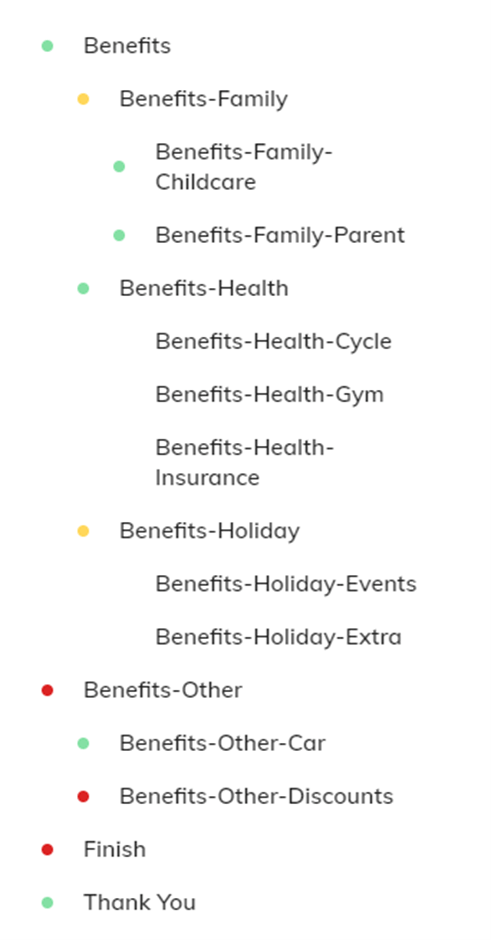
Hierarchial Benefits intent showing sublevels for Family, Health, Holiday, Other

Figure 1: A level 1 Benefits intent broken down into level 2 Family, Health, Holiday, Other and several level 3 sub-categories

If desired, you can simply use the intent hierarchy for logical structuring, then you can make all intent levels active in the required flows and stop there. However intent hierarchies become particularly powerful when you add the “Inherit Example Sentences from Child Intents” feature, shown in fig. 2.

Benefits-Health level 2 intent with training data and enabled inheriting from child intents

Figure 2: The Benefits-Health level 2 intent with its training data and inheriting from child intents enabled

By enabling “Inherit Example Sentences from Child Intents” on the Benefits and Benefits-Health intents, all training data in the level 3 -Cycle, -Gym and -Insurance sub-intents will be considered part of the larger Benefits-Health intent, and in turn all level 2 intents (-Family, -Health, etc.) will be considered part of the umbrella Benefits intent as well.

You can also set your intent lookups in a Cognigy flow to only search for intents down to a certain level. A handy way to utilize this is with finding what broad subject a user needs help with, and then moving them to an appropriate flow to narrow down the details. 

Using Intent Levels to Control Conversation Flow

Perhaps a user has a question about their employee health benefits. When they’re in the starter flow, you can set the intent lookup node to only operate at level 1, meaning the bot will only return the Benefits super-intent, and then, regardless of whether the user asked about health benefits, vouchers or a more general query under the “Benefits” subject, they will be directed to the separate “Benefits” flow. That way you don’t need to have lookups for every single sub-intent in the start flow—see figs. 3 & 4. 

Node edit diagram showing limitation on intent lookup node to only search level 1 intents

Figure 3: Declaring an intent lookup node should only search down to level 1 intent hierarchies – so only Benefits could be selected in this case.


Resulting bot interaction and json showing level 1 intents

Figure 4: The resulting bot interaction and the returned intent only showing level 1 in the response json

 Then, once the user is in the “Benefits” flow, the intent lookup node can instead be set to levels 2 or 3, allowing the user to ask more specific questions about health benefits, or even specific types of health-related benefits, if up to level 3 is enabled, see fig. 5.

Subsequent bot interaction and json with returned intent showing up to level 3

Figure 5: The subsequent bot interaction and the returned intent showing up to level 3 in the response json 

In Conclusion

Flows in Cognigy are best used for directing users on journeys where you filter down to their needs to put them on the correct path to fulfilment or the information they need. Intent hierarchies are very useful for this approach, allowing you to define both a broad subject matter, and more specific subjects within them. Still, it should be noted there remains a risk of confusion between higher-level and lower-level intents if their training data is very similar, and for that reason you should make sure to thoroughly test a variety of utterances on each flow and level-configuration that your hierarchical intents are used in.

QBox is now available to test your Cognigy chatbot models, allowing you to analyze your training data and help make improvements to performance. 
Read more about: Chatbots, Conversational AI Testing, Natural Language Processing (NLP), QBox

Ready for seamless CX assurance?

Learn how Cyara’s AI-led CX productivity, growth, and assurance engine can help you eradicate bad CX.

Speak to an expert
Office view with Cyara dashboard

Related Posts

conversational AI governance

November 13, 2025

Conversational AI Governance for CX: Ensuring Compliance, Bias Mitigation & Reliability

AI-powered CX channels handle millions of interactions every day. Deliver accurate and reliable CX with conversational AI governance.

Topics: Artificial Intelligence (AI), Conversational AI, Conversational AI Testing, Customer Experience (CX)

AI CX dealbreakers

November 12, 2025

New Survey Data: The AI Dealbreakers Making Consumers Ghost

As customer expectations and Agentic AI technology evolves, you must avoid dealbreakers and deliver quality interactions for best results.

Topics: Agentic AI, Artificial Intelligence (AI), Conversational AI, Conversational AI Testing, Customer Experience (CX)

conversational AI testing

August 28, 2025

Automated Testing for Conversational AI: A Game-Changer in Customer Support

The rise of AI-powered CX offer many key benefits... and risks. Learn how to ensure CX quality with a conversational AI testing solution.

Topics: AI Chatbot Testing, Artificial Intelligence (AI), Automated Testing, Chatbots, Conversational AI, Conversational AI Testing, Customer Experience (CX)

Footer

  • AI-Led CX Assurance Platform
    • Cyara AI Trust
    • Cyara Botium
      • Functional & regression testing for AI agents
      • LLM-driven AI agent testing
      • Load testing for AI agents
      • NLP analytics for conversational AI in CX
    • Cyara CentraCX
    • Cyara Cloud Migration Assurance
    • Cyara Cruncher
    • Cyara Number Trust
    • Cyara probeRTC
    • Cyara Pulse 360
    • Cyara Pulse
    • Cyara qualityRTC
    • Cyara ResolveAX
    • Cyara testingRTC
    • Cyara testRTC
    • Cyara upRTC
    • Cyara Velocity
    • Cyara Voice Assure
    • Cyara watchRTC
  • Use cases
    • Agent desktop testing
    • Cloud contact center monitoring
    • Contact center number test types
    • Contact center testing
    • Continuous testing
    • Conversational AI testing
    • CX monitoring
    • DevOps for CX
    • Email & SMS testing
    • Functional testing
    • Incident management
    • IVR discovery
    • IVR testing
    • Load & performance testing
    • Omnichannel testing
    • Outbound call testing
    • Regression testing
    • Voice biometrics testing
    • Voice of the customer
    • Voice quality testing
    • Web interaction testing
  • Resources
    • CX Assurance blog
    • Customer success showcase
    • Events & upcoming webinars
    • Resource library
    • On-demand webinars
    • Cyara portal & support site access
    • Customer community
  • About us
    • About Cyara
      • About us
      • Leadership
      • Careers
      • Cyara awards
      • Legal statements, policies, & agreements
    • Services
      • Cyara Academy
      • Consulting services
      • Customer success services
      • Technical support
    • News
      • CEO’s desk
      • Press releases
      • Media coverage
    • Partners
      • Partners
      • Integration & technology partners
      • Platform Integrations
  • LinkedIn
  • Twitter
  • YouTube

Copyright © 2006–2025 Cyara® Inc. The Cyara logo, names and marks associated with Cyara’s products and services are trademarks of Cyara. All rights reserved. Privacy Statement