Are Invisible Defects Limiting Your Revenue Potential?
Self-service is key to IVR success. When your IVR system empowers customers to get basic questions answered, submit information, and perform simple tasks without ever speaking to an agent, it’s a boon for your bottom line.
Simply having a self-service IVR or chatbot system in place doesn’t automatically result in higher profits, though. And, while it may be costly to deploy comprehensive service solutions across your various customer channels, those solutions aren’t complete without automated testing. In fact, if you only go halfway when implementing the system, you could end up with far lower profit increases than you had planned — and have a lot of frustrated customers on your hands.
Why? Because the true cost of manual testing is a lack of visibility into your IVR system. And that lack of visibility will cost you far more than an automated testing and monitoring solution.

What Self-Service IVR Does for Your Bottom Line
When you implement an IVR or chatbot solution for your call center, it’s always with the aim of improving customer service and enhancing profitability. Small businesses first transition from manually answering every call to using a basic self-service solution (even if it’s just a dial-by-number directory) because they realize they can’t keep up with the calls. Service suffers and labor costs go up — something has to change.
For larger enterprises, a more robust self-service solution is essential. To handle thousands of calls per hour, you need an IVR that can help many of those callers solve their issues without ever getting routed to a real person.
When you have that — and it’s working properly — it can save you an enormous amount of money. Recent data from Aragon Research shows that it’s not even close. While the cost of each human interaction with a customer ranges from $15 to $100, a virtual interaction only costs between $1 and $4. That’s pennies on the dollar. Imagine saving between $14 and $96 on every call — or $14,000 to $96,000 for every 1,000 calls. No wonder so many call centers opt for more and more advanced self-service solutions.
Will you actually realize those benefits, though? That depends on how you test.
The Costs of Invisible Errors
Here’s the rub with going all-in with self-service: As you offer more comprehensive self-service solutions, your agents will be directly involved with fewer of your customer interactions. And you should be getting a lot more calls. That’s the goal, right? But if you’re less involved and the calls are increasing, how do you know if everything is working?
All too often, call center operators try to manage this with manual testing. They perform occasional spot checks or test the system at regular intervals. But this approach can’t possibly keep up with the growing number of calls, especially the ones that are happening on the IVR and never getting to an agent. Ultimately, this means that countless defects and errors are slipping through the cracks, simply because you can’t see them.
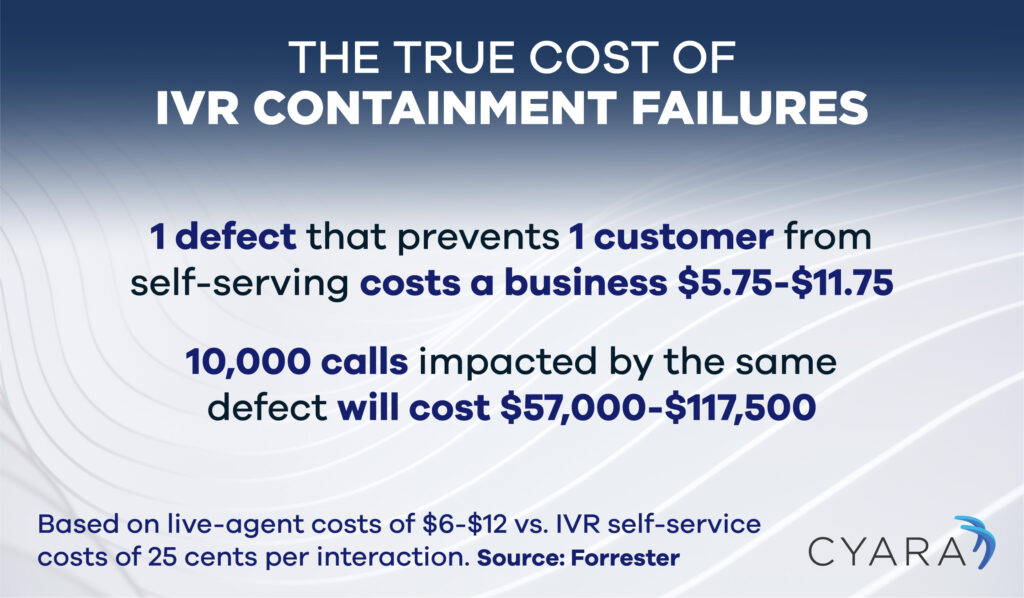
Consider the cost of those invisible defects. Again, each virtual call saves you $14 to $96. Any call that ultimately has to be handled by an agent negates those savings. And that’s fine if that call needs to be handled by an agent. But defects in the system mean a lot of calls go to agents when they shouldn’t. Each time that happens, you lose out on those savings.
Think about it from the perspective of one of our retail clients. This company handles an average of 7,200 calls per hour, and each transaction generates an average of $165 in revenue. What if some of those calls drop off and, as a result, transactions fall through? Worse, what if they have a defect bad enough to cause an hour of downtime? Keep in mind, too, that those losses are on top of any missed savings from failed self-service.
Taking it one step further, you can consider potential revenue losses in terms of customer lifetime value. One U.K. telecom provider estimated that one missed prospect call translated to £1.2 million ($1.4 million) in lost revenue over the lifetime of that potential customer.
Automated Testing Unlocks the Full Benefits of Self-Service
You get the idea. That’s a lot of missed revenue or lost savings, and it can add up quickly over thousands of calls. A manual testing solution simply can’t keep up with these demands.
The truth is that self-service IVR and automated testing go hand in hand. If you want to fully realize the benefits of the former, you need the latter. With automated testing and monitoring, you gain complete visibility into your IVR or chatbot system. You don’t have to wonder whether you’re missing any bugs that are causing customer frustration or dropped calls.
Case in point: The retail client we mentioned above experienced an error that would have taken two hours to find and fix with manual testing. At 7,200 calls per hour, that’s thousands of dollars in potential lost revenue. With automated monitoring, though, they caught the problem within minutes and didn’t miss a beat.
That’s what automated testing and monitoring can do for you. It pulls back the veil so you can see and solve every defect before it becomes a serious problem. Whether you’re using a self-service IVR or chatbot solution, having that kind of visibility will unlock its full potential.
Pull Back the Veil
If you’re already using an IVR or chatbot solution, you’ve undoubtedly experienced some of the benefits — maybe even significant ones. But, without automated testing, you don’t really know what you’re missing. To maximize the savings and revenue-generating potential of the self-service customer experience, you need to be able to see everything that’s happening so you can weed out the defects.
Ready to pull back the veil on your IVR? Contact Cyara to learn more about our award-winning CX assurance platform.