When a major product launch, billing cycle, or outage recovery event hits, customer experience systems are often the first to feel the strain. And when things go wrong, your customers are often the first to notice. Issues such as a virtual agent that stops responding, an interactive voice response (IVR) system that times out, or a messaging channel that lags by a few seconds can quickly turn a high-volume moment into a reputational crisis.
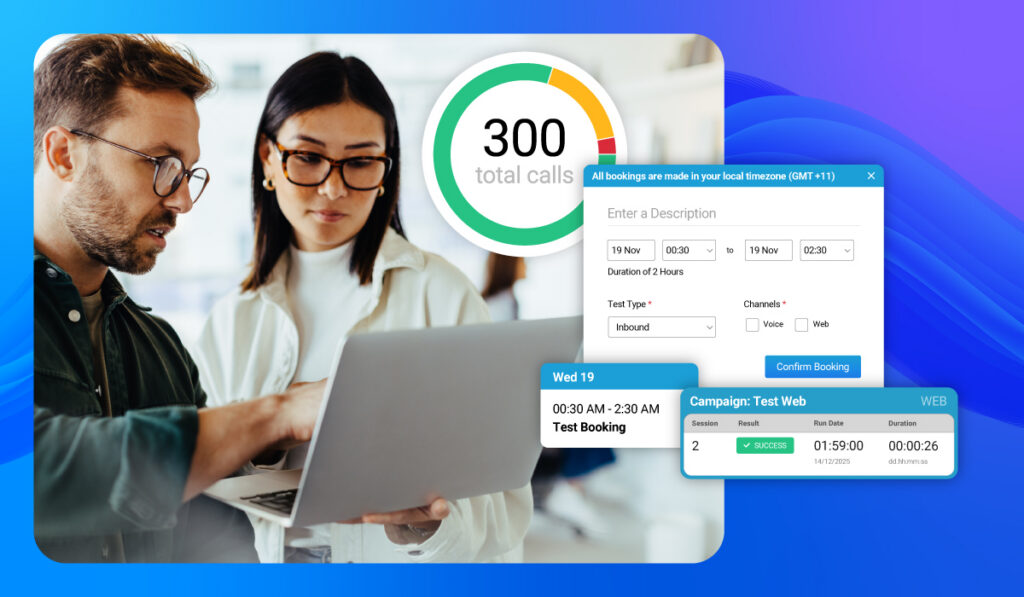
Ensure your CX delivers reliable interactions even during the busiest times of the year with automated load testing from Cyara.
CX load testing validates that customer experience systems perform reliably under peak demand. To scale it effectively, replace manual testing with automated solutions that can simulate tens of thousands of concurrent interactions across all channels. Automation provides the consistency, coverage, and speed needed to catch performance issues before customers do, giving you confidence that your systems will hold during critical high-traffic periods.
What is CX load testing?
CX load testing is the practice of simulating high volumes of customer interactions across contact center channels to validate that systems perform reliably under peak demand conditions. It tests whether voice, chat, email, and other customer touchpoints can handle real-world traffic surges without degradation. Effective CX load testing goes beyond generating volume by validating that every interaction works as intended even when volume, complexity, and dependency risk all increase at once.
Most organizations recognize the need for load testing. Far fewer are equipped to scale CX load testing in a way that reflects real customer behavior across channels, technologies, and peak demand scenarios. Scaling CX load testing isn’t just about generating more traffic; it’s about validating that every interaction still works as intended when volume, complexity, and dependency risk all increase at once.
By eliminating manual load testing and leveraging automation in your contact center, you can build an effective testing strategy that keeps your customer journeys performing as intended, even during extreme load and high-traffic conditions.
The limits of manual load testing strategies
Many organizations start with narrow testing efforts: a stress test of an IVR menu, a chatbot concurrency test, or a peak-hour simulation of agent login capacity. And while this type of strategy can be useful to validate individual aspects of a customer journey, such as during targeted functional tests or the earliest design stages, it fails to scale with growing business and increased CX complexities.
A single customer interaction crosses channels, involving a wide network of underlying systems necessary to progressing through the journey and meeting performance standards. However, as businesses continue to leverage innovative and AI-powered systems and pathways, CX ecosystems have become increasingly complicated, with a wide range of branching channels. While manual testing may be sufficient to verify performance for a single journey variation, it crumbles when it comes time to test thousands of concurrent interactions across all channels.
The limits of manual load testing strategies include:
Limited scale for simulating peak demand
Human testers can’t simulate real peak demand conditions or sudden traffic surges that real businesses face. Even large testing teams are limited by time and resource constraints. And, as a result, many performance issues are discovered only after countless customers have been affected and filed complaints.
Inconsistent test execution across releases
When manually testing your systems, it can be nearly impossible to replicate the same scenario across multiple test runs, leading to inconsistent data sets, gaps, and human error. This inconsistency makes it harder to compare results over time or detect subtle regressions introduced by configuration or content changes.
Reduced efficiency and resource bottlenecks
Manual testing is a major bottleneck for teams. Humans can only test so many variables and systems at a time. To try and meet deadlines, teams are forced to make judgement calls for where their efforts are best spent, leaving gaps in the infrastructure.
Incomplete coverage of omnichannel journeys
CX environments are vast, complex systems that support countless journey variations, error paths, and edge cases. And, as increasingly more enterprises implement agentic AI-powered systems, which can autonomously execute tasks and make decisions within customer interactions, the possible customer journey paths multiply. Every unverified path can house defects, which can easily slip through the cracks and into the live environment, where they’ll affect customers.
When businesses rely solely on manual load testing to validate system performance, they’ve already set their CX up for failure. Too many variables, too few resources, and tight deadlines make it impossible for a human team to handle the task alone. Instead of verifying all channels will perform under pressure, these teams have to cross their fingers and hope their infrastructure will hold under load.
And, too often, disaster strikes.
The only way to truly assure CX performance is with an automated, comprehensive load testing solution.
The advantages of leveraging automation
With an automated testing solution, you can scale your operations and meet business needs. When you make the switch to automation, you’re shifting your testing from a reactive, resource-intensive process to a proactive strategy that puts performance quality, innovation, operational efficiency, and customer satisfaction first.
Unlike the limitations of manual testing, automated load testing solutions can simulate tens of thousands of real-world customer interactions across multiple channels simultaneously. But these interactions aren’t meant to only generate volume. Instead, they follow defined journeys and simulate real customer activity, allowing you to understand exactly how well your systems perform during periods of peak traffic, such as a product release, holiday sale, or other critical seasons.
Automation also brings consistency and repeatability. The same journeys can be executed repeatedly across releases, environments, and demand scenarios, making it far easier to identify regressions or performance drift over time. When a configuration change or AI model update introduces unintended behavior, automated tests provide objective evidence rather than anecdotal signals.
Compared to manual tests, automation offers unmatched coverage and speed. As CX teams release more frequently and deploy new, AI-powered channels, automated load testing is key to validating a wide range and number of journeys without slowing innovation.
Key benefits of automated CX load testing:
• Simulate tens of thousands of concurrent interactions across voice, chat, and digital channels.
• Ensure repeatability and consistency across releases and environments.
• Provide objective performance evidence rather than anecdotal signals.
• Achieve comprehensive coverage of omnichannel journeys, including edge cases and error paths.
• Accelerate testing cycles without sacrificing quality or coverage.
• Identify performance regressions before they impact customers.
Ultimately, automation provides something manual testing cannot at scale: confidence. Confidence that systems will perform under pressure, that customer journeys will hold together across channels, and that failures, when they do occur, will be predictable so you can be ready to mitigate the damage.
Manual vs. automated load testing comparison
| Dimension | Manual Load Testing | Automated Load Testing |
| Scale | Limited to small teams; cannot simulate peak demand | Simulates tens of thousands of concurrent interactions |
| Consistency | Difficult to replicate scenarios; prone to human error | Repeatable execution across releases and environments |
| Coverage | Gaps due to time and resource constraints | Comprehensive testing of all channels and journey paths |
| Speed | Slow; creates bottlenecks in release cycles | Fast execution without slowing innovation |
| Confidence | Relies on assumptions and limited data | Provides objective evidence and real-time visibility |
Scale Limited to small teams; cannot simulate peak demand Simulates tens of thousands of concurrent interactions
Consistency Difficult to replicate scenarios; prone to human error Repeatable execution across releases and environments
Coverage Gaps due to time and resource constraints Comprehensive testing of all channels and journey paths
Speed Slow; creates bottlenecks in release cycles Fast execution without slowing innovation
Confidence Relies on assumptions and limited data Provides objective evidence and real-time visibility
Deliver better CX with Cyara’s automated load testing solutions
Customer interactions are no longer defined by isolated touchpoints. Each end-to-end journey crosses channels, involving multiple backend systems, all of which must perform as intended to meet customer expectations, especially during critical, high-traffic periods.
Customers don’t distinguish between systems, channels, or vendors. When your CX has an issue, customers are the first to notice, and they don’t give second chances.
Cyara empowers leading global enterprises to replace guesswork with real-time visibility and validation. By simulating real-world customer interactions, Cyara’s automated load testing provides a necessary confidence layer, revealing where experiences bend, where they break, and where improvements must be made.
As the leader of AI-powered CX, Cyara helps customer-obsessed global brands navigate rising customer demands and increased contact center complexities. With Cyara, you can gain visibility into every stage of the CX development lifecycle and deliver error-free omnichannel journeys—seamless customer experiences across voice, chat, email, and other channels—regardless of the channels your customers choose to interact with.
Contact us to schedule a personalized demo and see Cyara’s platform for yourself or visit cyara.com for more information.
Frequently Asked Questions
CX load testing is the process of simulating high volumes of customer interactions to validate that contact center systems, including voice, chat, and digital channels, perform reliably under peak demand conditions.
Perform CX load testing before major product launches, seasonal peaks, billing cycles, system upgrades, or any event expected to drive high customer contact volumes. Regular testing before each release also helps catch performance regressions early.
Automated CX load testing can cover voice (IVR and agent interactions), chatbots, SMS, email, web chat, and other digital channels, essentially any touchpoint in your omnichannel customer journey.
Automated load testing can simulate tens of thousands of concurrent interactions with consistent, repeatable execution, while manual testing is limited by team size, prone to human error, and cannot replicate real peak demand conditions.
AI-powered systems like virtual agents and agentic AI create more complex, branching customer journeys. Load testing ensures these systems maintain performance and accuracy when handling high volumes of simultaneous interactions.
CX load testing validates that customer-facing systems like IVRs, virtual agents, and messaging channels continue to perform as intended when traffic volume spikes. Without it, high-demand events such as product launches or holiday sales can expose failures that directly impact customers.
Manual testing is limited by time, resources, and human error, making it impossible to simulate thousands of concurrent interactions across all channels. These constraints leave gaps in coverage and often mean performance issues are only discovered after customers are already affected.
Automated load testing simulates real-world customer journeys across multiple channels, not just raw traffic volume. This approach reveals how systems perform end-to-end under peak conditions, including complex branching paths and AI-powered interactions.
Automated tests execute the same journeys repeatedly across releases, environments, and demand scenarios, making it easier to detect regressions or performance drift over time. This removes the inconsistency and human error that make manual test results difficult to compare.
Organizations should test for scenarios like major product launches, billing cycles, holiday sales, and outage recovery events. These are the moments when CX systems face the most strain and when failures are most damaging to customer trust.
Issues such as a virtual agent stopping mid-interaction, an IVR timing out, or a messaging channel lagging can quickly turn a high-volume moment into a reputational crisis. Customers do not distinguish between systems or vendors, and they rarely give second chances.
Cyara simulates real-world customer interactions to provide visibility into where experiences bend or break under pressure. The Cyara Agentic Platform helps global enterprises validate omnichannel journeys across every stage of the CX development lifecycle.