In a world increasingly shaped by automation and AI, the value of speaking to a real human has never been higher. For industries where customer experience performance is critical, such as airlines, healthcare, banking, and retail, the ability to connect users with live agents through video has become a strategic differentiator. But delivering that kind of quality experience at scale is no small feat.
Identify and eliminate WebRTC issues before they affect your customers with Cyara.

This is the story of how a major airline validated and launched a browser-based video support system that connects travelers to live agents during moments of disruption. With Cyara, the airline combined a contact center workflow engine with a real-time media platform to deliver a seamless agent-on-demand experience.
The vision: humanizing disruption
Airports get messy fast. The weather changes. Crews time out. Lines grow, and operational hiccups can leave travelers stranded and frustrated. When a leading airline set out to modernize its CX offerings, they envisioned a bold foundation for customer interactions: a browser-based video system that would allow travelers to speak to live agents in real time, right from their phones. This was about more than just convenience. The airline understood the importance of maintaining empathy and fostering stronger customer relationships. For customers, seeing a real person on the other end of the line builds trust, especially during high-stress moments.
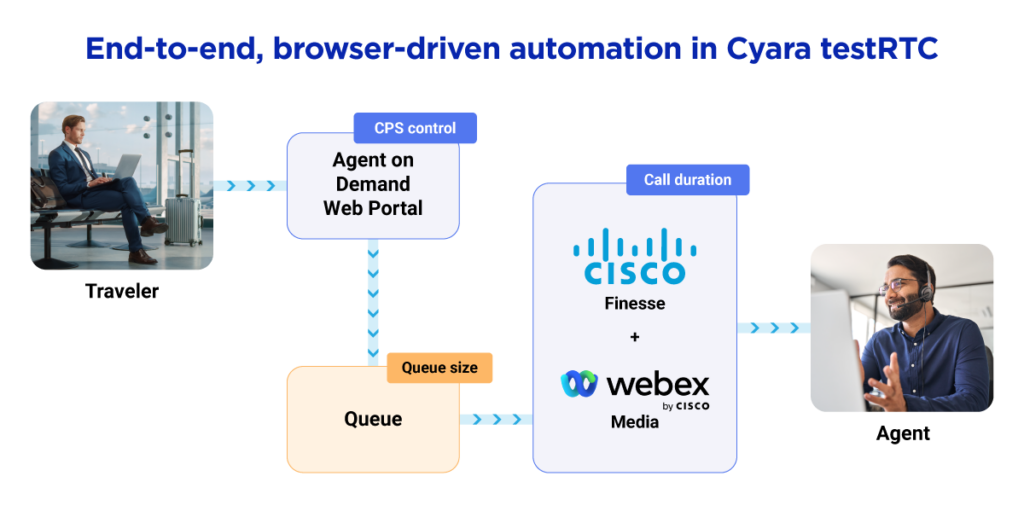
To make this vision a reality, two complex systems had to work in harmony: one handling the contact center workflows, the other managing real-time media. Together, they powered a new agent-on-demand experience. But before this could go live, it had to be tested, not just functionally, but under the kind of pressure such a system would be subjected to during peak travel chaos.
The testing challenge
The airline set ambitious goals for upgrading its CX offerings. It tasked Cyara with validating the system from end-to-end, simulating real-world travelers and agents who would use real browsers, real media, and real UI flows. The mission was to recreate production-like conditions: long queues, rapid call rotations, and unpredictable surges.
Traditional, manual testing processes and tools simply couldn’t cut it. The airline’s team needed full browser automation paired with deep WebRTC analytics to capture not just what failed, but why and when.
The benefits of real-time WebRTC assurance
To achieve its goals of delivering streamlined, error-free, WebRTC-based CX and to overcome the burden of manual, outdated testing, the airline needed a solution that would:
- Provide visibility across the development lifecycle: Confirming performance quality after launch is too late. Teams must be able to prove journeys work before launch to mitigate errors and improve efficiency.
- Test for real-world interactions: The testing solution must reflect real-world customer and agent activities, pinpointing vulnerabilities and defects in the same ways customers may encounter them.
- Validate performance under real load and pressure: Testing in a controlled environment isn’t enough. Travel brands must be sure their CX can handle hundreds of agents signed in, travel queues in thousands, and continuous arrivals without faltering.
Why the airline chose Cyara
Cyara’s solutions aren’t unit-testing libraries. By reproducing the airline’s exact user journey in real browsers with real audio and video, Cyara testRTC provided the airline’s team with several key benefits, including:
- Real browser automation across traveler and agent screens
- Precise controls for calls per second, queue depth, and call duration
- Per-call WebRTC analytics tied to UI steps and timestamps
- Repeatability so the QA team could prove a fix, then lock it in
That combination turned “it failed once” into hard, time-stamped evidence upon which the airline’s engineering teams could act.
Testing that mirrors real–world interactions
When testing, you must consider how real customers will experience your journeys. Instead of testing code snippets or mock flows, the airline’s team assessed CX performance based on the full traveler-agent journey. For example:
- Traveler enters the queue
- Agent accepts the call
- Chat loads
- Audio and video connect
- Call ends
- Repeat, hundreds of times
With Cyara’s help, the airline simulated real browsers, real media, and real UI flows. The process began on a smaller scale: a single agent and a small traveler queue. Even at this scale, three to four calls failed to connect. Without full automation, the airline’s team could not reproduce those failures reliably. But, with testRTC, UI action was paired with WebRTC stats on both sides and made the issues repeatable.
From there the rhythm was simple: fix, rerun, scale a bit, validate. This loop continued until the system could handle heavy queues and high arrival rates without falling over.
The first issues identified
During this thorough testing process, the following issues showed up early and often:
- Agent accepts, but no audio or video window appears
The accept event fired. Media never negotiated. Investigation showed the gap clearly. - Travelers stuck in queue while agents showed “ready”
Agents were available. Calls did not route. Queue logic diverged under pressure. - UI fields were set but not applied
Automation filled controls correctly. State drifted during load. We caught the mismatch with logs and step-by-step replays. - Operational errors after a few calls
Issues surfaced quickly in controlled runs, not weeks later in production. - Agents blocked from accepting new calls
Teardown lag created a dead zone where new calls could not start cleanly.
The WebRTC quality traps
The tests also identified quality problems that were not devices or bad networks, such as:
- Bitrate too high for the tile size
The app drove multi-megabit video into small tiles. Load went up, clarity still wobbled. We recommended sizing the starting bitrate to the actual render size, then stepping up only when stable. - Slow ramp and oscillation
Streams took tens of seconds to settle and hunted up and down. That created visible swings in quality and longer time to first clear frame. We tuned the ramp policy to be steadier at the start. - Region affinity for media
At higher join rates, calls sometimes landed on distant media servers. Round-trip time climbed and jitter spiked. We pushed for region affinity with sensible fallback rules.
These are classic WebRTC footguns. They are also fixable once you can see them clearly in context.
Scaling performance without breaking the line
As the airline’s infrastructure continued to scale, another class of problems appeared, including:
- Cyber-physical systems (CPS) sensitivity
Above a certain join rate, failures rose across setup, reconnect, and room creation. The system needed explicit back-pressure and admission control, not optimistic defaults. - Queue behavior under stress
Travelers occasionally failed to join when spikes hit. Agents sometimes could not accept new calls until teardown was complete. Cyara’s solutions made these visible and reproducible, so the owners could adjust queue and retry policies.
The pattern stayed the same. Make it fail the same way every time. Fix the cause. Prove it in the next run.
Why WebRTC testing matters for all industries
The same pressures show up anywhere a customer wants a real human, on video, right now. These are the patterns to test, and the evidence to publish, when you roll out a WebRTC video contact center.
In healthcare: triage, check-ins, device support
Use case snapshot
Virtual check-ins, pre-visit triage, chronic-care follow-ups, device troubleshooting with a video agent in the browser
Unique testing focus
- Privacy and compliance flows end to end
- Network variability on mobile and hospital Wi-Fi patterns
- Long consults: soak testing for memory leaks or quality drift
In banking and insurance: know your customer (KYC), claims, fraud resolution
Use case snapshot
High-trust video sessions for identity checks, document walkthroughs, and claim resolution
Unique testing focus
- Screen-share readability at small zoom levels
- Reconnect behavior under loss and jitter
- Queue surge behavior during lunch and close-of-day spikes
In retail and luxury shopping: demos, try-ons, concierge handoffs
Use case snapshot
Live product demo with a video agent in multi-tile layouts and quick agent rotations
Unique testing focus
- Tile-aware bitrate adaptation during zooms and gallery switches
- Handoff latency and UI state integrity between back-to-back sessions
- Weekend and evening surge with load testing and soak testing
In travel and hospitality: rebooking, check-in, concierge
Use case snapshot
Rebooking, cancellations, and check-in during irregular ops with a video agent
Unique testing focus
- Hub-and-spoke regional media routing and traveler proximity
- Holiday surge readiness with CPS ramps and queue honesty checks
In education: classrooms, tutoring, admissions
Use case snapshot
Virtual classes, tutoring, admissions interviews, and tech support with a human on video
Unique testing focus
- Device recourse diversity across laptops, tablets, phones, older browsers
- Breakout orchestration and escalation from bot to human tutor
- Session continuity across long lessons with reconnects
In government services: citizen support and benefits
Use case snapshot
Virtual appointments for benefits, identity verification, and public services across mixed devices
Unique testing focus
- Accessibility and low-end device compatibility, including kiosks
- Secure media handling and identity flows
- Peak-demand windows like tax filings or emergency response
In real estate and proptec: tours, inspections, leasing
Use case snapshot
Live virtual tours, unit inspections, and leasing conversations with a video agent
Unique testing focus
- Rapid pans and zooms without clarity collapse
- Cross-device clarity for curbside mobile viewing
In field services, utilities, and telecom: remote diagnostics at outage scale
Use case snapshot
Guided fixes, inspections, and outage recovery on routers, set-tops, smart devices, and industrial gear
Unique testing focus
- Mobile and rugged devices on real browsers under low CPU and memory
- Unstable links: Wi-Fi congestion, and cellular networks modeled in load testing
- Session continuity and escalation to a remote expert without losing context
- Screen-share responsiveness on constrained bandwidth
Improve QA and CX operations with WebRTC assurance
WebRTC testing is valuable for businesses from all industries, for a wide variety of use cases.
- Test the real journey in browsers → early connect failures and routing gaps surfaced before launch
- Pair UI steps with per-call WebRTC stats → anecdotes became timestamped evidence that sped up fixes
- Right-size starting bitrate to tile size → steadier quality under load and faster time to a clear frame
- Enforce media region affinity with safe fallback → lower round-trip time (RTT) and jitter during spikes
- Define CPS and queue guardrails → predictable behavior at high join rates, no mystery timeouts
- Keep teardown clean and observable → agents stay unblocked for the next call
- Run the same scenario as a release gate → regressions show up in the lab, not at the airport gate
- Scale in small, repeatable steps → start small, fix, scale, validate; momentum beats heroics every time
- Run soak tests for long sessions → catch drift, memory growth, and mid-call degradation
- Exercise reconnect scenarios (loss, app restart, device sleep) → faster recovery and fewer abandoned sessions
- Verify screen-share responsiveness under constrained bandwidth → readable docs and usable guidance when networks are busy
- Publish outcome metrics that matter → connection success at peak, time to live human, queue drain SLOs, reconnect success, and jitter/RTT within targets
Scale your WebRTC interactions with Cyara
Agent on demand only works if a traveler can reach a real person fast during the worst hour of the day. When a leading airline looked for a solution capable of testing the journeys customers actually take, Cyara delivered. By pairing every UI step with per-call WebRTC analytics, and scaling in controlled steps until surge behavior was predictable, Cyara’s solutions helped the airline achieve its strategic CX goals and deliver reliable interactions at scale.
If you’re planning a video agent rollout or want to pressure-test an existing WebRTC video contact center, contact us for a personalized demo.