An interactive voice response (IVR) system is an automated phone system that interacts with callers through voice prompts and keypad inputs to route calls, provide information, or complete transactions without human assistance. A broken IVR includes dead ends, misroutes, failed prompts, and outdated menu options that prevent customers from reaching their intended destination.
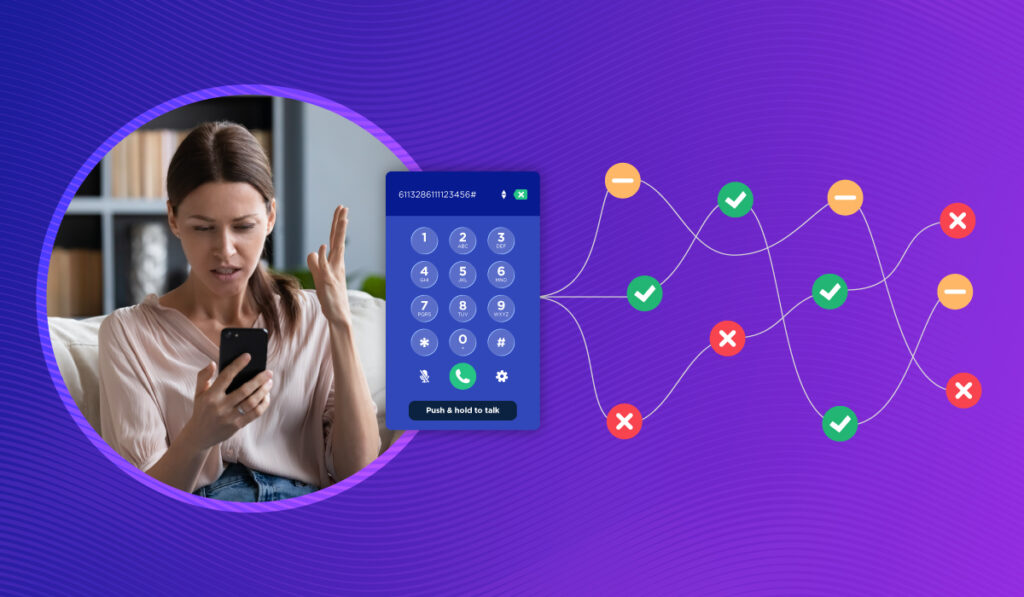
A broken IVR—including dead ends, misroutes, failed prompts, and outdated menu options—directly damages customer trust, agent productivity, operational efficiency, and brand reputation. The consequences extend to regulatory compliance risks and significant revenue loss. Proactive automated IVR testing provides the visibility needed to identify and fix issues before they affect customers.
Fpr example, a customer picks up the phone to call your company. Maybe they’re trying to update a credit card, check their flight status, resolve a billing error, or reach support for a product that suddenly stopped working. In this scenario, they’re expecting quick answers to their questions and an easy resolution so they can carry on with their day. But instead, they get lost in a broken, outdated IVR) menu that leads to dead ends instead of solutions.
Learn how you can deliver seamless, error-free interactions with automated IVR testing solutions.
When issues like these occur, your customer isn’t considering the logistics telephony carriers, routing rules, backend logic, or prompt dependencies. They’re thinking something far simpler and far more dangerous to your business: “This company doesn’t know what it’s doing.”
Unfortunately, while IVRs are responsible for setting the tone for an entire customer interaction, many organizations fall victim to easily avoidable issues, putting their customer trust, brand reputation, compliance, and bottom line at risk. When IVRs work well, customers hardly notice it. When it fails, they notice immediately, and rarely forgive it.
A broken IVR isn’t just a technical glitch. It’s a direct hit to customer trust, agent productivity, operational stability, and brand reputation. But with the right IVR testing solutions in your arsenal, you can gain visibility, improve CX performance, and eliminate issues before they can affect your customers.
What happens when an IVR breaks?
The moment an IVR begins to malfunction, the customer journey unravels. Your customers depend on your IVR to guide them to the right department, understand the next steps, and feel confident they’re making progress to have their issue resolved. But once they encounter a broken menu option or reach a dead end, they will lose trust in your brand entirely.
And once your customer becomes aware of persistent issues, their frustration spreads quickly. It influences how they speak to agents, how they remember the company, and how they talk about the brand afterward. A simple misroute can turn an otherwise routine inquiry into an emotional outburst by the time the customer reaches a live person.
A broken IVR is more than a simple inconvenience, and it leads to long-lasting consequences for your entire organization. The five key business impacts include:
- Agent performance decline – Agents handle misrouted calls, apologize for system failures, and absorb customer frustration
- Operational inefficiency – Repeat calls, manual transfers, and extended handle times drain resources
- Brand reputation damage – Negative experiences spread through word-of-mouth and online reviews
- Regulatory compliance risks – Missing disclosures and failed authentication create audit failures and penalties
- Revenue loss – Missed calls, dropped transactions, and eroded customer loyalty impact the bottom line
How does a broken IVR affect agent performance?
While customers suffer through the front end of a broken IVR, agents bear the weight on the backend. A malfunctioning IVR disrupts call flow, rerouting customers to the wrong place or funneling them into an overloaded queue. Suddenly, agents find themselves handling inquiries they aren’t trained for, apologizing for issues they didn’t cause, and absorbing the emotional intensity of callers who have been stuck in a loop or misled by the system.
When the IVR fails, handle times rise, escalations increase, and stress levels spike. Even high-performing teams begin to feel burned out when every call begins with an apology for something outside their control. So not only does a broken IVR frustrates your customers, but it directly keeps agents from performing at their best, leading to low productivity and high turnover.
How does a broken IVR impact operational efficiency?
Unlike a system outage, IVR problems often reveal themselves through subtle symptoms such as slightly higher call volume, longer handle times, unexpected spikes in escalations, or callers reaching unexpected queues. Without proactive IVR testing and monitoring solutions, these signals appear as isolated anomalies rather than part of a larger breakdown. But reality is much different.
Callers who can’t complete tasks through the IVR call back repeatedly, increasing demand on the system. When they reach the wrong department, agents must transfer them manually, adding unnecessary time to every interaction. When prompts fail to collect information, agents must gather it themselves, extending calls and reducing capacity.
How does a broken IVR damage brand reputation?
A broken IVR breaks your promises to deliver consistent, reliable, and accurate customer service. When your customers need you most, an unoptimized IVR sends a signal that your customers’ satisfaction isn’t a priority, and that you aren’t there for them.
Customers who have bad experiences rarely keep their frustrations hidden. Instead, they talk negatively to their family members and friends about their poor experiences, and others go online to create social media posts or write negative reviews. And these stories travel quickly, undoing your investments into your marketing and brand and influencing whether other potential customers will choose your brand over a competitor in the future.
What are the compliance risks of IVR failures?
In highly regulated industries like finance, healthcare, insurance, and government, IVRs often play a critical role in regulatory compliance. They deliver mandatory disclosures, route sensitive calls properly, and support identity verification protocols. When these components fail, compliance risk rises quickly.
In healthcare, a broken IVR that fails to route emergency calls correctly could delay critical care and violate patient safety regulations. In banking, a malfunctioning IVR during peak hours could result in thousands of failed transactions and authentication failures.
All it takes is a single missing disclosure, a misrouted call, or an IVR that fails to authenticate a caller properly to cause significant regulatory violations or audit failures. These consequences are not just financial but reflect directly on an organization’s credibility and operational integrity. And, in many cases, the cost of noncompliance dwarfs the operational cost of the IVR failure itself.
How do broken IVRs cause revenue loss?
Every missed call is a missed opportunity, every dropped call is a lost sale, and every misrouted caller is a person whose problem takes longer to solve—and whose loyalty becomes more fragile.
In industries with high call volumes or time-sensitive transactions like retail, travel, banking, and healthcare, the financial impact of even a short-lived IVR failure can be severe. And because IVR failures often persist unnoticed, the revenue leakage continues quietly, day after day. In some cases, businesses don’t discover the true cost until they piece together data from multiple systems, only to realize the financial damage has already been done.
Broken IVRs are much more than a single, isolated issue. It has far-reaching, lasting consequences that impact your organization’s overall success, bottom line, and future. But, by taking proactive steps with automated IVR testing, you can overcome these obstacles and deliver more efficient, seamless CX.
The need for increased visibility into IVR performance
IVRs are complex, branching systems that evolve continuously through menu updates, new prompts, promotions, technical changes, and routing adjustments. Despite this complexity, many organizations test them only sporadically, often relying on outdated, manual processes, and only after changes are made.
But testing once every blue moon simply isn’t enough to deliver the high-quality interactions your customers expect and demand from their trusted brands. With an automated IVR testing solution, you can gain real-time visibility into your performance, empowering your team to proactively identify and remediate CX issues before they affect your customers.
Best practices for preventing IVR failures
Organizations often treat IVR problems as technical defects. But a broken IVR behaves more like a crack in the foundation of customer experience. It undermines trust, disrupts operations, increases costs, stresses employees, and damages brand perception, all at once.
To protect your customers and brand, implement these IVR maintenance best practices:
- Test continuously – Implement automated testing that runs regularly, not just after updates
- Monitor in real-time – Use monitoring solutions to detect issues as they emerge
- Validate all paths – Test every menu option, branch, and routing rule systematically
- Review after changes – Test thoroughly following any system updates, promotions, or backend modifications
- Track key metrics – Monitor call completion rates, transfer rates, and customer feedback for early warning signs
With the right IVR testing and monitoring solution, you can set your IVRs up for success and deliver the quality interactions your customers depend on.
The Cyara Agentic Platform helps enterprises by testing, monitoring, and optimizing omnichannel customer journeys across voice, chatbots, and all digital channels, including AI-emerging channels.
Contact us today to schedule a personalized demo or visit cyara.com for more information.
Frequently Asked Questions
What causes IVR failures?
IVR failures typically result from software updates that introduce bugs, backend system changes that break integrations, outdated menu options that no longer match current offerings, misconfigured routing rules, and lack of regular testing after changes are deployed.
What are the warning signs of a broken IVR?
Warning signs include increased call volumes, longer average handle times, higher escalation rates, customers reaching unexpected queues, repeat callers attempting the same task, and rising customer complaints about phone system navigation.
How can businesses prevent IVR breakdowns?
Businesses can prevent IVR breakdowns by implementing automated testing solutions that continuously validate all IVR paths, monitoring performance in real-time, testing after every system change, and establishing clear ownership of IVR maintenance within the organization.
How much does a broken IVR cost a business?
The cost varies by industry and call volume, but broken IVRs impact revenue through missed sales opportunities, increased operational costs from longer handle times and repeat calls, potential regulatory fines in compliance-sensitive industries, and long-term brand damage from negative customer experiences.
What is a broken IVR and why does it matter to businesses?
A broken IVR is an interactive voice response system that fails to route callers correctly, delivers dead ends, or malfunctions in ways that disrupt the customer journey. It is more than a technical glitch because it directly damages customer trust, brand reputation, and revenue.
How does a malfunctioning IVR affect contact center agents?
When an IVR fails, agents receive misrouted calls, handle inquiries they are not trained for, and absorb the frustration of callers who have already been stuck in a broken menu. This leads to longer handle times, higher stress, lower productivity, and increased turnover.
What are the financial consequences of IVR failures?
Every missed, dropped, or misrouted call represents lost revenue, and in high-volume industries like retail, banking, travel, and healthcare, even a short-lived IVR failure can cause significant financial damage. Because IVR failures often go undetected, the revenue leakage can continue quietly for days before the full cost is understood.
How can a broken IVR create compliance risks?
In regulated industries like finance, healthcare, and insurance, IVRs deliver mandatory disclosures, route sensitive calls, and support identity verification. A single missing disclosure or misrouted call can trigger regulatory violations or audit failures, and the cost of noncompliance often far exceeds the operational cost of the IVR failure itself.
Why is sporadic or manual IVR testing not enough?
IVRs evolve continuously through menu updates, new prompts, and routing changes, making infrequent manual testing insufficient to catch issues before they reach customers. Without proactive testing, problems surface as subtle symptoms like rising call volumes or unexpected escalations rather than being identified and resolved early.
How does a broken IVR damage brand reputation?
Customers who experience a broken IVR often share their frustration with friends, family, and online audiences through reviews and social media posts. These negative experiences spread quickly and can undermine marketing investments while influencing whether potential customers choose your brand over a competitor.
How does automated IVR testing help prevent these issues?
Automated IVR testing provides real-time visibility into system performance, allowing teams to proactively identify and fix issues before they affect customers. It simulates real-world call flows at scale, making it possible to validate routing, prompts, and integrations continuously across a complex, evolving system.
What is Cyara’s role in IVR testing and monitoring?
Cyara is the number one leader in AI-powered CX assurance and helps enterprises test, monitor, and optimize omnichannel customer journeys across voice, chatbots, and digital channels. Its solutions are designed to help organizations eliminate broken IVR experiences and deliver consistent, reliable customer interactions.